By the time a B2B prospect books a call with your sales team, they've typically already visited six to ten pages of your website and formed most of their opinion about whether you're credible. We've reviewed enough analytics dashboards for clients across Canada to see the same handful of leaks appear again and again, well before anyone picks up a phone.
The pricing page problem
B2B buyers want a sense of scale even when exact pricing depends on scope. Sites that hide all pricing signals — no ranges, no "starting at," no packages — push visitors to leave and compare a competitor's transparent pricing page instead. We recommend at minimum a "typical projects range from $X to $Y CAD" statement, even on complex service pages, because it filters out mismatched leads before they reach your sales team and reduces wasted discovery calls.
Case studies without numbers
"We helped a client improve their online presence" tells a buyer nothing. Case studies that convert include a specific before-and-after metric: conversion rate lift, page load time improvement, lead volume change over a defined period. If your case studies don't have at least one hard number each, they read as filler rather than proof, and buyers scroll past them.
Contact forms that ask too much, too soon
We audit form fields on every new client site. A first-touch contact form asking for company size, budget range, timeline, and a phone number before a prospect has even talked to a human is a common source of drop-off. Our rule of thumb: name, email, company, and a single open text field for the first form. Qualify further on the call.
Mobile experience that doesn't match desktop
We still find B2B sites where the desktop version has a polished navigation and clear calls to action, but the mobile version truncates the menu, hides the phone number below three scrolls, or breaks the contact form entirely. Given that a meaningful share of B2B research now happens on mobile during commutes or between meetings, this gap costs more leads than most teams realize. Run your own site through Google's Mobile-Friendly Test and PageSpeed Insights before assuming it's fine.
Page speed above three seconds
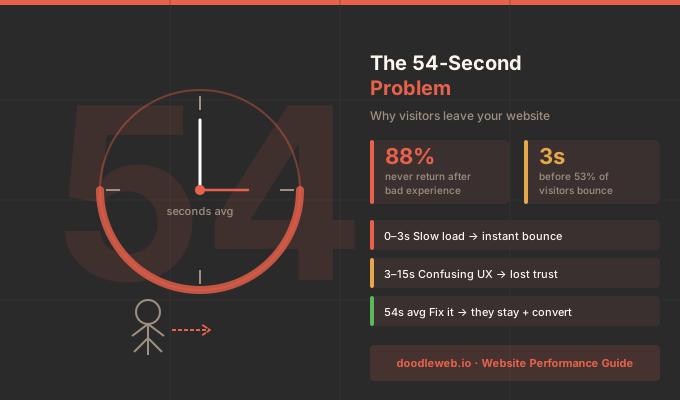
Every additional second of load time above two seconds measurably increases bounce rate, and B2B buyers comparing three or four vendors will not wait for a slow site to load when a competitor's loads instantly. Common causes we find during audits: unoptimized hero images (uncompressed 4–8MB files), render-blocking third-party scripts (chat widgets, marketing pixels, video embeds all loading synchronously), and no CDN in front of a Canadian-hosted site serving national or international traffic.
Testimonials with no attribution
A quote with no name, title, or company attached reads as fabricated, even when it's real. Full attribution — name, role, company, and ideally a headshot or logo — is the minimum bar for a testimonial to do any persuasive work. Video testimonials convert better still, but even a well-attributed text quote outperforms an anonymous one.
A simple audit you can run this week
Pull your last 20 lost deals from your CRM and ask two questions: did the prospect visit the pricing page, and did they visit a case study page. If most of your losses never reached either page, the problem may be navigation and internal linking rather than the content itself — buyers can't act on proof they never found.
We run this exact audit as the first step of any conversion-focused engagement, usually inside a two-week diagnostic before we touch any design work. If your website traffic looks healthy but your close rate doesn't match it, that gap is almost always sitting somewhere in the six leaks above.
Want us to run this audit against your own analytics and CRM data? We can usually flag the biggest leak within a week.
Surrey, BC
A full-service digital agency working in WordPress, Drupal, Shopify, Webflow, React, and React Native. We partner with universities, governments, and growing brands to ship sites and products that hold up after launch.