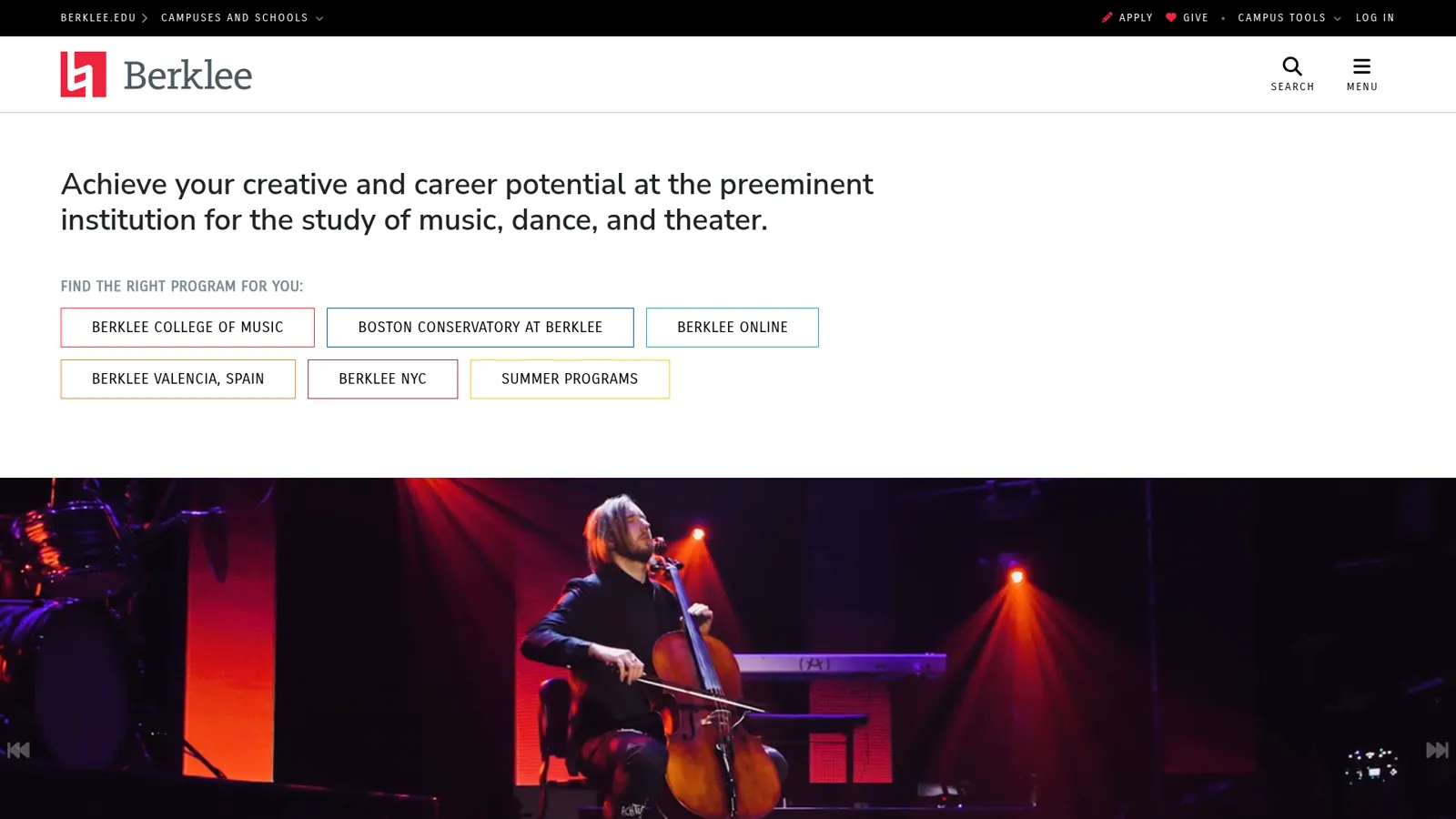
DoodleWeb helped Berklee College of Music transition from Drupal 7 to Drupal 8. The confirmed engagement included theme implementation and backend development, coordinated as parts of one successful platform transition.
This case study intentionally separates confirmed project facts from general migration guidance. We do not publish undisclosed timelines, content volumes, performance gains, team sizes, or private technical details.
What did DoodleWeb do for Berklee?
The work covered two connected areas: Drupal theme implementation and backend development. Both were part of Berklee's move from Drupal 7 to Drupal 8.
That distinction matters. A major Drupal migration is not simply a content copy or a visual reskin. The theme depends on the content structures and output produced by the backend, while backend decisions affect how templates, navigation, and editorial features behave. Treating those workstreams separately can create avoidable rework. The Berklee engagement approached them as one transition.
You can also view the concise Berklee case study or explore our current Drupal development services.
Why was Drupal 7 to Drupal 8 a major transition?
Drupal 8 represented a significant architectural change from Drupal 7. For organisations moving between those versions, the work was closer to a replatform than a routine update. Teams had to understand what the Drupal 7 site did, decide how that behaviour should work in Drupal 8, and then rebuild or adapt the relevant parts.
For a higher-education institution, the website also has to support many kinds of information and stakeholders. Program information, institutional content, navigation, templates, and publishing needs all intersect. A transition therefore needs a shared plan for content presentation and backend behaviour.
The useful lesson is still current. Organisations moving from a legacy Drupal release to a supported version should not assume that installing a newer core version completes the work. The real scope includes content models, themes, modules, integrations, permissions, redirects, testing, training, and launch support.
How theme implementation fits into a Drupal migration
A Drupal theme controls more than colours and typography. It determines how content fields, navigation, forms, and reusable page elements are presented across devices. During a version transition, old template assumptions may no longer match the new system.
Theme implementation therefore needs to follow a clear inventory:
- List the page and content templates used on the Drupal 7 site.
- Identify which templates remain necessary and which can be consolidated.
- Map the content fields each template expects.
- Rebuild reusable theme patterns for Drupal 8.
- Test real content in each pattern rather than relying only on sample text.
- Review responsive behaviour, keyboard use, forms, and error states.
For Berklee, theme implementation was a confirmed part of the engagement. We do not claim undisclosed details about the institution's design system or the number of templates involved.
What backend development covers
Backend development is the work that makes the platform behave as required behind the rendered pages. In a Drupal transition, that may involve content structures, custom functionality, module decisions, data handling, permissions, and integrations. The exact Berklee implementation is private, so those items should be understood as a general planning checklist rather than a description of undisclosed project scope.
A responsible backend workstream usually begins with an inventory. Every custom module, contributed module, content type, taxonomy, role, workflow, form, scheduled task, and external connection should have an owner and a destination decision. The team then decides whether each item will be migrated, rebuilt, replaced, consolidated, or retired.
This prevents a common failure mode: reproducing years of accumulated complexity without asking whether it still serves the institution.
What made the transition successful?
The verified outcome is that DoodleWeb helped Berklee complete a successful Drupal 7-to-8 transition with theme and backend work included. The clearest practical lesson is coordination.
Theme work needs stable content structures. Backend work needs to understand how those structures will appear to visitors and editors. Testing needs representative content. Launch planning needs both workstreams to reach readiness together. When those dependencies are visible early, teams can resolve them before cutover rather than during it.
A useful transition plan includes shared checkpoints:
- content and functionality inventory approved;
- theme requirements mapped to content structures;
- backend functionality available for end-to-end testing;
- representative pages reviewed with real content;
- issues triaged by launch impact;
- cutover ownership and rollback decisions documented;
- post-launch support responsibilities agreed.
What should higher-education teams ask before migrating?
Start with questions that expose dependencies rather than focusing only on the destination version.
- Which content types and fields are still actively used?
- Which templates rely on custom Drupal output?
- Which modules support essential workflows?
- Which integrations must be tested with external owners?
- Which URLs need to remain stable or redirect?
- Which roles need access to create, review, approve, and publish?
- Which pages represent the hardest content and interaction cases?
- Who can approve the theme, content model, backend behaviour, and launch?
These questions help turn a broad migration goal into an executable plan.
How does this experience apply to current Drupal moves?
Drupal 8 is no longer a current destination. Organisations planning a migration today should target a supported Drupal release selected for their requirements and maintenance horizon. Berklee's Drupal 7-to-8 transition is relevant as evidence of DoodleWeb's legacy Drupal migration experience, not as a recommendation to move to Drupal 8 now.
Current migrations still benefit from the same integrated approach: audit first, map content and functionality, rebuild the theme against the destination architecture, test complete user journeys, and launch through a documented cutover.
Our higher-education Drupal migration service explains the current process, while the Drupal 7-to-11 migration page covers a supported modern destination.
How can DoodleWeb help with a Drupal transition?
DoodleWeb plans and delivers Drupal migrations with theme, backend, content, testing, and launch dependencies considered together. For universities and colleges, we also account for distributed ownership, editorial governance, accessibility requirements, and the need to keep essential public information available throughout the move.
If you are planning a move from Drupal 7 or another legacy CMS, contact DoodleWeb Canada to discuss the current platform, required functionality, and the evidence needed for a safe cutover.
Related reading
- Berklee College of Music case study
- Drupal migration services for higher education
- Drupal 7-to-8 migration guide for universities
- Drupal 7 end-of-life migration guide
- Drupal 11 migration field guide
Surrey, BC
A full-service digital agency working in WordPress, Drupal, Shopify, Webflow, React, and React Native. We partner with universities, governments, and growing brands to ship sites and products that hold up after launch.