The content management landscape is shifting on three fronts at once: AI is changing both how content gets written and how it gets discovered, headless architecture is going from niche to default for new builds, and the line between "website" and "content platform serving multiple channels" is disappearing. Here's what we're actually seeing change in client work, not speculation.
AI-assisted authoring is now a real editorial workflow
Contentful, Sanity, and WordPress (via plugins like AI Engine) now ship AI-assisted drafting, alt-text generation, and content summarization directly in the editor. The practical shift for content teams: a first draft that used to take 90 minutes now takes 20, but editorial review time has gone up proportionally because AI-generated drafts need fact-checking and a pass for house voice. Teams that skip that review step end up publishing confidently-worded but factually loose content — we've seen this cost clients credibility when an AI-drafted comparison table cited outdated pricing.
Content structured for AI answer engines, not just search engines
With ChatGPT, Gemini, Perplexity, and Google's AI Overviews now sitting between a lot of searchers and your website, content structure matters differently than it did for classic SEO. What we're changing in client CMS setups:
- Explicit schema.org markup (Article, FAQPage, HowTo) generated from structured fields rather than hand-coded, so it stays accurate as content changes
- Clear, extractable answer paragraphs near the top of long-form content — a direct answer to the implied question before the elaboration, because that's what gets pulled into AI-generated summaries
- Author and organization entity markup tied to a consistent knowledge graph presence, since AI systems weight source credibility signals more heavily than traditional keyword matching
None of this requires a platform change — it requires a content model that separates the "answer" from the "explanation" as distinct structured fields, which most CMS platforms support once you set the fields up.
Headless is becoming the default for anything multi-channel
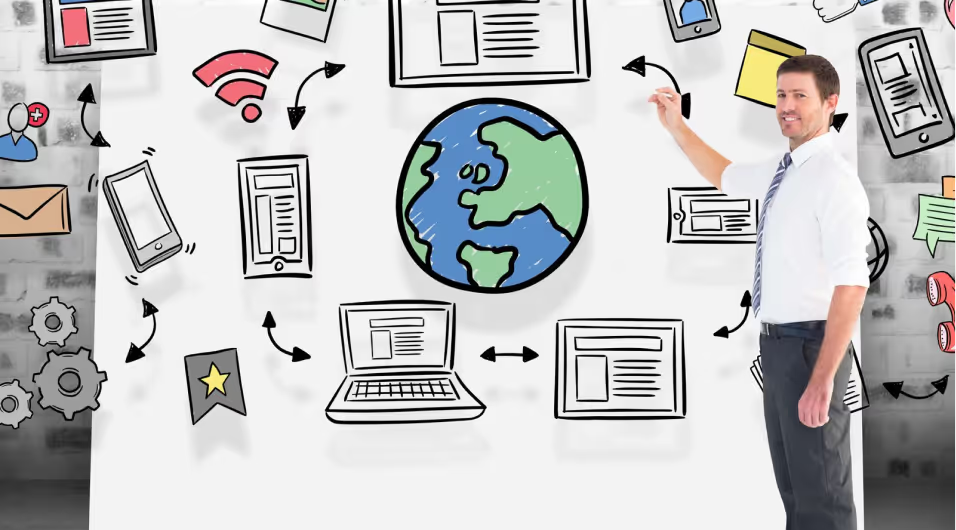
If you're publishing the same content to a website, a mobile app, digital signage, or a partner API, maintaining that content in three separate coupled CMS instances is now clearly the wrong pattern. Headless platforms (Contentful, Sanity, Storyblok) or hybrid setups (Drupal via JSON:API, WordPress via WPGraphQL) let you author once and syndicate everywhere. The adoption curve we're seeing: organizations with a single website are staying on coupled CMS platforms because the added complexity isn't justified; organizations with two or more content-consuming channels are moving to headless within their next platform refresh.
Composable architecture and the "best of breed" stack
Related to headless is the composable trend: instead of one monolithic platform doing CMS, commerce, and search, teams are assembling best-of-breed pieces — a headless CMS for content, a dedicated search vendor (Algolia, Elasticsearch) for site search, and a separate commerce engine — connected via APIs. This gives more flexibility but shifts real integration and maintenance burden onto whoever owns the architecture. It's the right call for larger teams with dedicated engineering resources; it's usually the wrong call for a five-person marketing team that needs one system they can manage without a platform engineer.
What we're telling clients to actually do about this
Three concrete moves, not speculation:
- Add structured "direct answer" fields to your content model now, even if you're staying on a coupled CMS — this is a content-modelling change, not a platform migration.
- Audit your schema.org markup coverage; most sites we look at have it on maybe 30% of eligible pages.
- Before committing to headless, count your actual content-consuming channels. If it's one, the migration cost isn't justified yet — revisit when a second channel is on the roadmap.
Not sure whether your current CMS setup is ready for how content discovery is changing? Send us your sitemap and we'll flag the structural gaps worth fixing first.
Surrey, BC
A full-service digital agency working in WordPress, Drupal, Shopify, Webflow, React, and React Native. We partner with universities, governments, and growing brands to ship sites and products that hold up after launch.