University website development done right.
Senior-led higher education website development for universities and colleges — accessible, high-performance, and built around the audience journeys that actually move student engagement.
When to hire us for this
Everything that ships with every engagement.
Higher-ed sites carry constraints most marketing sites do not. These are the deliverables built in from day one — not phase two.
Prospective-student journeys
Applicant, transfer, graduate, and international pathways mapped and designed as first-class experiences — not a subsection under 'Admissions'. Program discovery, cost estimators, and next-step CTAs your enrollment team can trust.
Program catalogs at scale
Program pages built from a structured content model, not a copy-and-pasted PDF. Filterable by degree level, format, department, and outcome — with schema so ChatGPT and Gemini cite the right program in AI answers.
WCAG 2.2 AA accessibility
Automated axe and pa11y checks in CI, manual NVDA/JAWS/VoiceOver testing, and a VPAT for every launched site. AODA and Accessible Canada Act conformance for federally regulated and Ontario institutions.
SIS and CRM integrations
Banner, Colleague, PeopleSoft, Slate, Salesforce Education Cloud, TargetX. Live program data, application status, and event registration wired into the site without shadow spreadsheets.
Multi-site and federated IA
Drupal multi-site or WordPress multisite with a shared design system so departments, schools, and centers can ship their own pages without breaking the brand or the analytics.
AEO for admissions
Organization, Course, and EducationalOccupationalProgram schema plus entity pages so prospective students find your programs when they ask ChatGPT, Claude, Gemini, or Perplexity — not just Google.
Six steps, one conversation.
Linear enough for a campus governance committee to plan around, flexible enough to do good work.
Discover
Stakeholder interviews across admissions, academic affairs, communications, IT, and advancement. Analytics audit, content inventory, and accessibility baseline.
Strategize
Federated IA, prospective-student journey mapping, program-catalog content model, integration plan (SIS, CRM, LMS), and a governance model your campus can actually staff.
Design
Brand-true visual system, page templates for every audience, and a component library your internal team can extend. Accessibility reviewed at every step, not audited at the end.
Develop
Drupal, WordPress, or headless React engineering. Automated accessibility CI, structured content, and a decoupled component library ready for department-level authoring.
Launch
Content migration with SEO-safe redirects, staging QA, VPAT, training for editors across departments, and a coordinated cutover with rollback plan.
Support
Care-plan retainer for accessibility, small features, integration work, and quarterly AEO/SEO reporting so admissions content keeps performing after launch.
Higher-ed web platforms, picked for fit.
Drupal for flagships and research institutions. WordPress for departments, program microsites, and content-heavy sites. Headless React for program tools and portals with deep SIS/CRM integration.
Education work we are proud of.
A few recent engagements where audience-led IA, accessible design, and integrated content-ops came together.
Four ways in, one quality bar.
Pick the engagement that fits your campus timeline. We'll tell you honestly if a different tier is a better fit.
A school, center, or program site that has to ship in a semester, not a year.
- Up to 20 templated pages
- Program listing + detail pattern
- WCAG 2.2 AA + VPAT
- Analytics + editor training
Flagship .edu redesign with federated IA and full audience coverage.
- Prospective, current, faculty, alumni journeys
- Program catalog content model
- SIS or CRM integration
- Design system + editor documentation
Ongoing higher-ed partner, on retainer.
- Accessibility monitoring + fixes
- Admissions-cycle feature work
- Integration + content-ops support
- Quarterly AEO/SEO reporting
Migrate from a legacy CMS (Drupal 7, SharePoint, Cascade, OU Campus) to a modern platform.
- Content migration + SEO-safe redirects
- Design system rebuild
- SIS/CRM re-integration
- Editor training across departments
The things higher-ed leaders ask most.
Real results from real engagements.
A snapshot of the higher education website development engagements where DoodleWeb owned strategy, design, and engineering end-to-end.
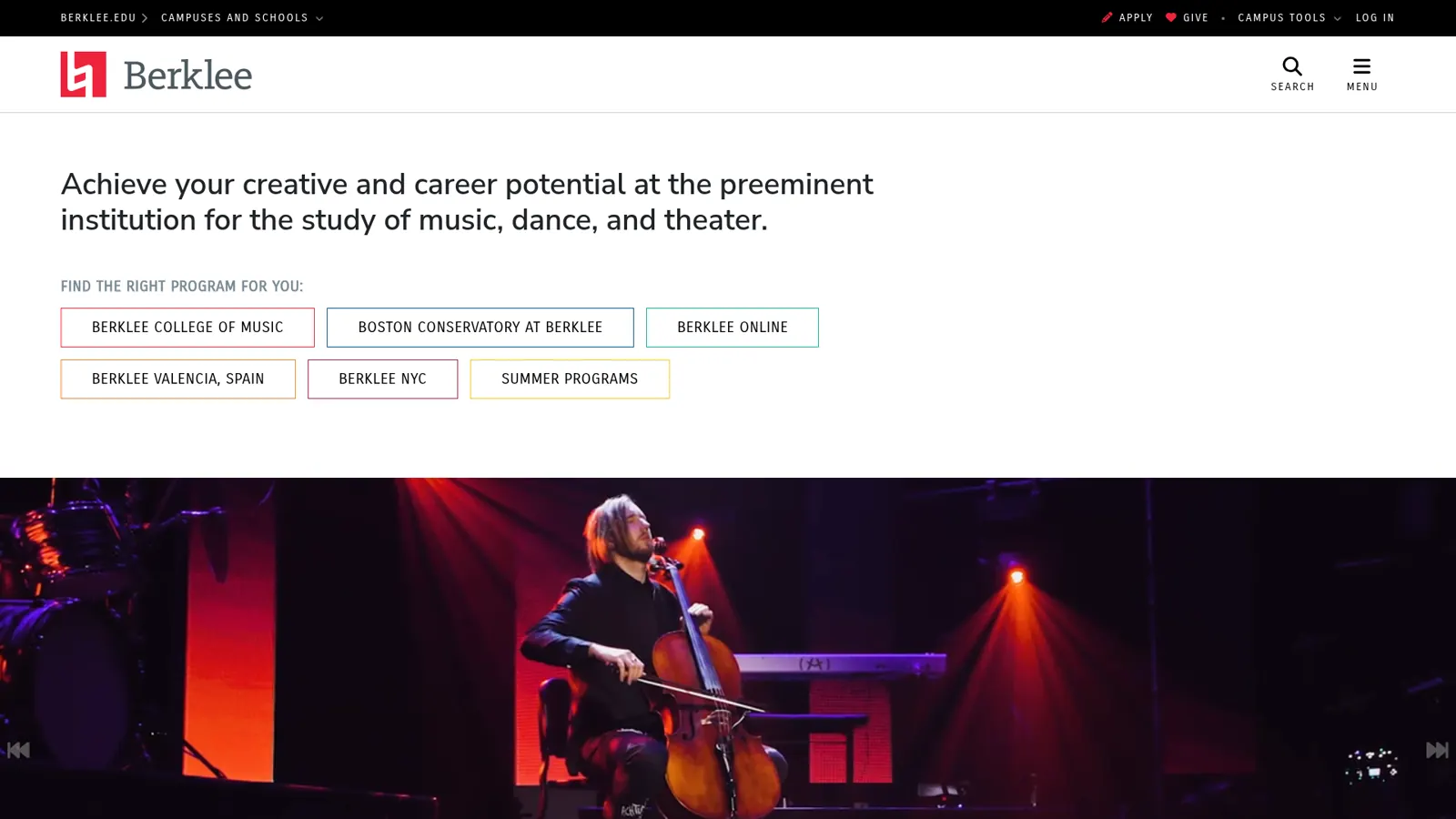
Berklee College of Music
DoodleWeb helped Berklee College of Music transition from Drupal 7 to Drupal 8. The engagement combined theme work and backend development so the institution could move to Drupal 8 as one coordinated transition rather than treating the public-facing experience and the underlying platform as separate projects.

George Brown College
George Brown College engaged DoodleWeb for a full AODA and WCAG 2.2 AA accessibility audit and remediation across their Drupal 10 platform serving 30,000+ students, 100+ editors, and 8 faculties. Combined automated scans (axe-core, Pa11y, Lighthouse CI) with manual expert testing (NVDA, JAWS, VoiceOver, keyboard-only) surfaced 412 unique WCAG failures across 47 templates. In 24 weeks, DoodleWeb closed 100 percent of Level A and AA issues, shipped an AODA-conformant component library, delivered a VPAT 2.5 (WCAG 2.2 AA and AODA), lifted the average Lighthouse accessibility score from 74 to 98, and trained 100+ editors on accessible content practices. The college now publishes across faculties without reintroducing barriers, backed by weekly automated regression scans in CI.

Trinity Western University
Trinity Western University hired DoodleWeb for a WCAG 2.2 AA accessibility audit and remediation across their Drupal recruitment platform. A video-heavy, animation-rich site had accumulated barriers: autoplaying hero video without controls, insufficient contrast on brand overlays, missing captions on 60+ program videos, keyboard-inaccessible mega menu, and quicklinks without discernible labels. Over 18 weeks DoodleWeb ran a full manual and automated audit (axe-core, Pa11y, NVDA, JAWS, VoiceOver, keyboard-only), closed 287 unique WCAG 2.2 AA failures, added prefers-reduced-motion support across every animation, captioned 60+ program videos, delivered a VPAT 2.5 and a public accessibility statement, and lifted the Lighthouse accessibility score from 71 to 97. The site now competes visually with top global universities without excluding prospective students who rely on assistive technology.
Young Americans Center
Young Americans Center for Financial Education runs the only bank in the world for kids alongside a set of hands-on programs, AmeriTowne, International Towne, Money Matters, YouthBiz, and summer camp, that teach financial literacy to youth. Two audiences, two brands, one mission, and previously two disconnected websites. DoodleWeb ran a brand and experience repositioning, then rebuilt the platform on WordPress at WP Engine: a sub-brand system that lets Young Americans Center, Young Americans Bank, and each program keep its own color world while sharing one component library, program pages that lead with a plain-language promise instead of nonprofit jargon, and an editorial model that keeps mission content and regulated bank content cleanly separated. Shipped in 18 weeks. WCAG 2.2 AA conformant.
Got a higher education website development project in motion?
Tell us where you are and where you'd like to be. A senior strategist replies — not a sales BDR — usually within a business day.
- Reply within one business day
- Senior team only — no juniors, no offshoring
- Fixed-fee proposals, no change-order surprises